Muzzleloading comes with plenty of questions, whether you're setting up your first inline muzzleloader, experimenting with a new powder, troubleshooting a breech plug, or trying to squeeze a little more accuracy out of your current setup.
For this episode of the Muzzle-Loaders Podcast, we collected questions directly from our social media audience and customer service team. Chance and Darren sat down to answer some of the most common—and a few of the more unusual—muzzleloader questions we've received recently.
From Blackhorn 209 primers and powder alternatives to FireStick muzzleloaders, percussion caps, barrel fouling, CVA breech plugs, ramrods, and sabot selection, there's a lot to cover.
Can Different 209 Primers Affect Accuracy With Blackhorn 209?
Yes. Your choice of 209 primer can affect the consistency of Blackhorn 209 and, ultimately, the performance of your muzzleloader.
Blackhorn 209 requires a relatively hot ignition source. If your primer doesn't provide consistent ignition, you can potentially see inconsistencies in how the powder burns.
Those inconsistencies can translate into variations in velocity and accuracy.
For Blackhorn 209, hotter 209 primers such as CCI 209 Magnum and Federal 209A primers are commonly preferred. Other hot 209 primers can also work well.
The important thing is to use an ignition system appropriate for Blackhorn 209 and approved for your particular muzzleloader.
Blackhorn 209 also requires an appropriate breech plug and ignition system. Always follow your muzzleloader and powder manufacturer's recommendations before developing a load.
Can You Use Blackhorn 209 in a Flintlock?
No.
Blackhorn 209 isn't intended for traditional flintlock ignition.
A flintlock relies on sparks igniting priming powder in the flash pan, which then carries ignition through the touch hole to the main powder charge.
Blackhorn 209 requires a hotter, more direct ignition source and should only be used in muzzleloaders and ignition systems specifically compatible with it.
For a flintlock, use a powder appropriate for traditional flintlock ignition and follow the firearm manufacturer's recommendations.
What Is the Best Alternative to Blackhorn 209?
There's no perfect direct replacement for Blackhorn 209.
One of Blackhorn's biggest advantages is that it combines strong performance with exceptionally clean burning characteristics compared with many traditional black powder substitutes.
If Blackhorn 209 isn't available, Pyrodex Select is one alternative we've used.
In our testing, Pyrodex Select produced strong velocities and actually averaged approximately 120 FPS faster than Blackhorn 209 in the particular setup we tested. However, it also produced considerably more fouling.
Triple Seven is another option.
In our testing, Triple Seven produced velocities closer to Blackhorn 209 and burned somewhat cleaner than Pyrodex Select, although neither powder matched Blackhorn's clean-burning characteristics.
This creates a tradeoff.
Pyrodex Select can provide excellent velocity but requires more attention to fouling and cleaning. Triple Seven can provide another balance of performance and cleanliness.
Remember that these powders aren't interchangeable charge-for-charge. Always follow the manufacturer's published loading data for the specific powder and muzzleloader you're using.
What About the Powder Inside Federal FireStick?
Federal FireStick provides another interesting comparison.
The proprietary powder contained within the FireStick shares some of the characteristics people appreciate about Blackhorn 209, including clean burning and reliable performance.
The important difference is that this powder isn't sold as a conventional loose muzzleloader powder. It's part of the Federal FireStick system and is intended for muzzleloaders designed specifically around FireStick technology.
That means FireStick isn't simply a substitute powder you can pour into a conventional inline muzzleloader.
You need a FireStick-compatible muzzleloader.
Are FireStick Rifles Really Muzzleloaders?
This question depends somewhat on how you're defining a muzzleloader.
From a hunting and functional standpoint, we consider FireStick rifles muzzleloaders. The projectile is still loaded through the muzzle, while the premeasured FireStick charge is inserted through the breech.
FireStick changes the powder-loading and ignition process, but the projectile remains muzzle-loaded.
It's similar to the debate that occurred when inline muzzleloaders became popular. At the time, an inline looked dramatically different from the sidelock rifles muzzleloader shooters had been using for generations.
Today, inline muzzleloaders are an established part of modern muzzleloading.
FireStick represents another evolution.
For new muzzleloader hunters in particular, the simplified loading process can reduce some of the initial learning curve associated with measuring and carrying loose powder.
That doesn't mean FireStick replaces traditional muzzleloading. Instead, it provides another way for people to enter the sport.
Some shooters may stay with FireStick rifles indefinitely. Others may eventually explore conventional inlines, percussion rifles, and even flintlocks.
Are FireSticks Water Resistant?
One of the practical advantages we've seen from FireStick technology is its moisture resistance.
In previous testing, we submerged FireSticks in water for extended periods and were still able to fire them afterward without an issue.
That can be particularly valuable for hunters dealing with unpredictable rain or snow.
Moisture has always been an important consideration with muzzleloaders, so reducing that variable can make a FireStick rifle appealing for hunters in states and seasons where the system is legal.
As always, check your current hunting regulations before choosing a FireStick muzzleloader for a particular season.
How Long Do No. 11 Percussion Caps Last?
There isn't a simple expiration date for No. 11 percussion caps.
Storage conditions are more important than age alone.
Keep your percussion caps dry and protect them from large swings in temperature and humidity. Their original manufacturer container stored in a climate-controlled location is a good starting point.
We've encountered percussion caps that have been stored properly for many years and continue to function.
Moisture is the bigger concern.
If caps are allowed to get wet or repeatedly experience conditions that create condensation, their reliability can be compromised.
Take care of them, keep them dry, and properly stored percussion caps can remain usable for a very long time.
What's Our Bucket-List Muzzleloader?
This question is considerably more subjective.
For Darren, one of the top traditional choices would be a high-quality Kentucky long rifle, particularly a well-made flintlock reproduction. There's something unique about owning and shooting a firearm that connects you directly with the history and traditions of early American muzzleloading.
Chance's traditional pick was a Thompson/Center Hawken.
The reputation of the original Thompson/Center sidelocks has endured for decades, and we've spoken with countless customers over the years who still shoot and maintain their original T/C rifles.
On the inline side, both of us already have rifles that fit our particular hunting applications extremely well.
The CVA Accura series remains a favorite for that reason.
The CVA Endura is another muzzleloader that's difficult to ignore because of its long-range capabilities and ability to use Blackhorn 209 as well as manufacturer-approved smokeless loads.
Ultimately, a bucket-list muzzleloader doesn't have to be the newest, fastest, or most expensive rifle available. Sometimes the appeal is craftsmanship, history, or simply owning something you've wanted to shoot for years.
Why Are Traditional Muzzleloaders Becoming Popular Again?
Part of the appeal of traditional muzzleloading is that it isn't optimized for convenience.
Modern technology increasingly removes steps from almost everything we do. Traditional muzzleloading moves in the opposite direction.
Loading a flintlock or percussion rifle is slower and more methodical. The rifle itself may be based on a design that's hundreds of years old. The experience connects you with a different period of firearm and American history.
That's part of what makes traditional muzzleloaders special.
You don't have to give up modern inline muzzleloaders to appreciate traditional ones, either. They're different experiences, and there's plenty of room in muzzleloading for both.
Should You Clean Between Shots When Sighting In a Muzzleloader?
Maybe.
Every muzzleloader can respond differently to barrel fouling.
Some rifles shoot their best groups from a slightly fouled barrel. Others begin losing consistency relatively quickly and benefit from being swabbed between shots or every few shots.
When sighting in, shoot controlled groups and watch what happens.
Three- or five-shot groups can help you identify patterns. If your first few shots group well but later shots begin wandering, fouling may be affecting your rifle.
Try swabbing the bore and repeat the test.
You don't necessarily need to perform a complete deep cleaning between every shot. A few appropriate wet patches followed by dry patches may be enough during range testing.
Pay particular attention to fouling near the breech and make sure the bore and breech plug are properly dry before loading again.
The objective is to determine what produces repeatable performance from your particular rifle and load.
Should You Fire a Fouling Shot Before Hunting?
That depends on how your muzzleloader performs.
If your rifle consistently shoots best from a slightly fouled bore, it may make sense to prepare it accordingly before hunting.
The important thing is to establish that routine at the range first.
Don't assume that a fouled bore is automatically more accurate. Test your rifle from a completely clean bore and compare those results with subsequent shots.
If shots two through four consistently group better than the first shot from a clean barrel, that's useful information when deciding how to prepare the rifle before hunting.
The most important principle is repeatability.
You want the muzzleloader in a known condition when you're hunting rather than guessing where the first shot will impact.
Can a Chronograph Help Determine When to Clean?
Absolutely.
Accuracy on the target tells part of the story, while a chronograph can give you another valuable data point.
We've seen muzzleloaders experience noticeable velocity decreases as fouling accumulates.
If your group begins opening and your chronograph simultaneously shows a significant velocity change, that's a strong indication that barrel condition may be affecting performance.
You don't need a chronograph to develop an accurate muzzleloader load, but if you have access to one, it can help you better understand what's happening between shots.
Is Measuring Muzzleloader Powder by Weight More Accurate Than Volume?
Theoretically, measuring powder by weight can provide greater precision than measuring by volume.
Whether that additional precision creates a meaningful improvement in muzzleloader accuracy is a separate question.
We haven't completed enough controlled testing to put a number on that difference yet.
It's something we want to test more extensively because the results may depend heavily on the muzzleloader and application.
A highly optimized long-range setup may benefit more from extremely precise powder measurement than a typical hunting muzzleloader being used at relatively short distances.
Until we have controlled testing to support a stronger conclusion, we wouldn't claim a specific accuracy improvement from measuring by weight.
Also remember that black powder substitutes can have specific volume-to-weight conversions. Never assume that a volumetric charge and an equal number of grains by actual weight are interchangeable. Follow the powder manufacturer's loading instructions.
Why Won't My CVA Close After Installing a New Breech Plug?
This is one of the more common CVA troubleshooting questions we've encountered.
CVA inline muzzleloaders can use different breech plugs depending on the powder and setup. When installing a new breech plug, you may find that the action doesn't close properly or the firearm doesn't operate as expected.
The new breech plug may need to be properly seated to that particular muzzleloader.
The breech plug installed in your muzzleloader at the factory has already gone through this initial seating process.
When replacing it with another compatible CVA breech plug, follow CVA's current installation procedure for that particular rifle and breech plug.
Because the breech plug is a critical component of the firearm's ignition and pressure system, don't force the action closed or attempt to fire a muzzleloader with an improperly seated breech plug.
If you're uncertain about installation, consult CVA's instructions or contact the manufacturer or our customer service team before proceeding.
Why Doesn't My CVA Ramrod Have Threads on Both Ends?
If you have a newer CVA muzzleloader, you may notice that the ramrod doesn't look like older CVA ramrods.
That doesn't necessarily mean it's defective.
CVA changed the design and removed the exposed threads from the end opposite the palm saver. One reason discussed for the change was preventing pointed projectiles, particularly bullets with aggressive ballistic tips, from interacting with those threads during loading.
The ramrod is still usable with threaded accessories.
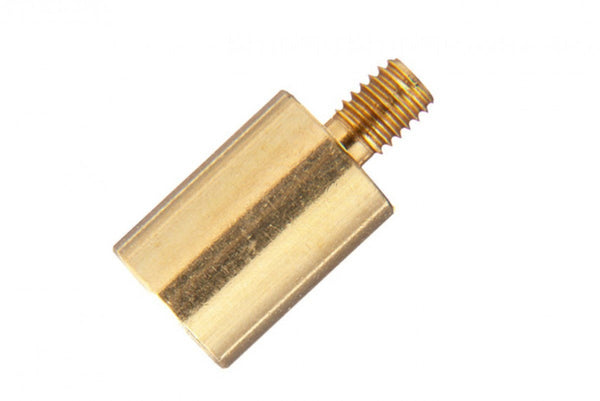
Remove the palm saver and you'll find the threaded connection in the brass ferrule underneath. These are standard 10-32 muzzleloader accessory threads.
You can install the appropriate loading jag there, turn the ramrod around, and slide the palm saver over the opposite end to provide a larger surface for your hand while seating the projectile.
It's different from the older design, but the ramrod remains functional.
For shooters who prefer the traditional double-ended configuration, aftermarket ramrods with threaded accessory connections are also available.
How Do You Choose the Correct Sabot for a Muzzleloader Bullet?
A sabot does more than simply fill the space between a smaller-diameter projectile and the muzzleloader's bore.
Proper fit matters.
Ideally, the bullet should fit securely and evenly inside the sabot. You don't want the projectile rocking around inside it, nor do you want the sabot petals excessively flaring outward.
Sabot length also needs to correspond appropriately with projectile length.
As a general guideline discussed in the podcast, the sabot petals should terminate near the area where the bullet begins transitioning into its ogive rather than extending unnecessarily high around the curved portion of the projectile.
A heavier, longer projectile may therefore require a different sabot than a shorter, lighter bullet.
Think of the relationship between the projectile and sabot like a hand fitting into a glove.
The projectile should sit securely in the base, the petals should fit evenly along its sides, and the overall combination should be appropriate for your muzzleloader's bore.
If you're using the sabot supplied by the bullet manufacturer for that particular projectile, much of this work has already been done for you.
When mixing bullets and sabots from different manufacturers, however, fit becomes something you'll need to evaluate more carefully.
There Is Always More to Learn About Muzzleloading
One of the great things about muzzleloading is that there's almost always another variable to experiment with.
Primer selection can affect ignition. Powder choice changes fouling and performance. One muzzleloader may prefer a slightly fouled bore while another needs to be swabbed frequently. Even something as seemingly simple as sabot length can influence how a projectile fits and performs.
That's why range time is so valuable.
Use manufacturer recommendations as your starting point, change one variable at a time, and pay attention to what your particular muzzleloader is telling you.
And if you run into a question you can't answer, reach out to the team at Muzzle-Loaders.com. Our customer service team works with muzzleloaders every day and is happy to help troubleshoot your setup.




Leave a comment